Enhancing Due Diligence Standards in the Reinsurance Sector
ArticleEnhancing Due Diligence Standards in the Reinsurance Sector
The regulatory environment is increasingly demanding structured due diligence practices. This holds true in the reinsurance industry, where legislation in most jurisdictions requires regulated entities to conduct rigorous third-party due diligence to ensure that they have reasonable knowledge of the third parties with which they are associated.
These regulations comply with the recommendations and guidelines of international organizations, such as the Financial Action Task Force (FATF)[1], among others, which are responsible for standardizing mechanisms for combating money laundering, terrorist financing, and other crimes that threaten the stability of international business and weaken the financial system.
By reasonable knowledge, we mean having a broad understanding of the characteristics and conditions of the companies and individuals we deal with. Obtaining a legible passport copy used to satisfy the need to identify an individual. However, as the concept of due diligence matured with advancements in global business practices, it became necessary to validate the legitimacy of the digital documents received. For this purpose, validation mechanisms such as the Machine Readable Zone (MZR) serve as a form of authenticity verification.
In commercial activities developed as B2B (business to business), and mainly in between companies regulated and supervised for the prevention of money laundering, a common challenge when conducting due diligence is to standardize the requirements and how we carry out the request and collection of information. In addressing this growing concern, guidance on the criteria for identifying the beneficial owner of legal persons was issued by FATF in 2023[2], which among others enables companies to align their internal third-party due diligence procedures with those set out by the FATF. Since companies can leverage public and up-to-date information, this information can be collected without straining the business relationship with extensive requests.
A significant step in identifying beneficial ownership involves the criterion of administrative control. This approach enables the establishment of the relationship between available company information, financial data, business activities, and the identity of individuals who make decisions and benefit from the company’s operations.
For this tendency to be effective, it is important that regulated entities not only maintain updated documents and information that satisfy jurisdiction-specific due diligence requirements, they also ensure these are made available to their strategic and business partners. At the same time, it is equally important for regulators and supervisors to understand the nature of B2B relationships, and supra-regulated businesses such as the insurance and reinsurance industry, and may in some circumstances deem the adoption of a simplified due diligence model appropriate.
Consider a situation where 2 regulated entities entered into a business relationship after completing due diligence on each other. Both entities are supervised by the same regulatory and supervisory body. Subsequent to this, one of the entities was found embroiled in an ongoing investigation for allegations of money laundering, which came to light after revelations of compliance alerts, regulatory inquiries, and negative news. This raised a critical question regarding who has the greater responsibility of assessing the reputation and market conduct of the regulated entity under investigation.
Building on the above example, let’s examine the due diligence process in a reinsurance contract involving a reinsurer, broker, cedant, and ultimate insured(s). In the reinsurance industry, it is well-established that a reinsurer's client is the cedent, and brokers act as intermediaries to facilitate business. As such, the responsibility for conducting thorough due diligence and reasonably identifying the third parties involved extends to entities regulated to the same extent as the reinsurer.
This contrasts with the relationship between insurers or cedants and their ultimate insureds, where the entities and individuals involved may not always be regulated, and whose information may not necessarily be publicly available. Each sector, jurisdiction, and supervisory authority is responsible for developing guidelines and methodologies that allow regulated entities to implement the most effective prevention mechanisms, in alignment with the highest standards.
From a compliance leadership perspective, these insights reflect the collective efforts of the Mandarin Re team to integrate regulatory expectations into daily operations. Through close coordination across departments, we continue to strengthen our due diligence practices and reinforce a shared commitment to ethical business conduct and regulatory alignment. This collaborative approach helps embed a robust culture of compliance throughout the organization and ensures that Mandarin Re remains resilient and competitive in an increasingly complex regulatory landscape.
About Zuleymi Velasco Pérez
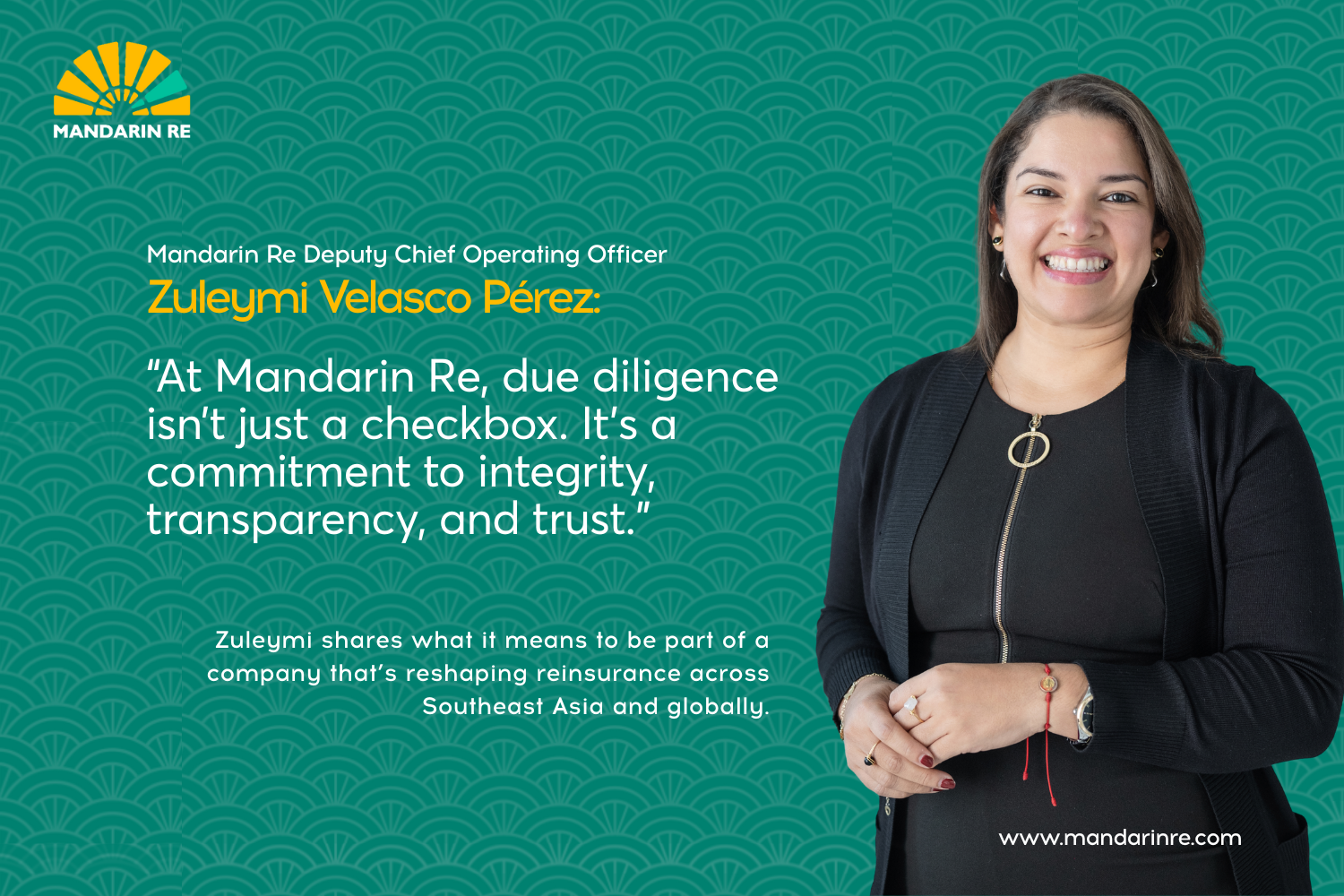
Zuleymi Velasco Pérez is the Deputy Chief Operating Officer at Mandarin Re. A distinguished Panamanian lawyer and professor, she brings an impressive track record in business management, law, compliance, ethics, and corporate governance. With a strong focus on risk management and a passion for fostering growth, she has driven impactful improvements across both the private and public sectors.
Known for her exceptional ability to bridge gaps between people, ideas, and strategies; Zuleymi excels at crafting innovative solutions to complex challenges. Her dedication to research and analysis has been instrumental in developing sustainable strategies that consistently deliver meaningful results.
For more information about Mandarin Re, please visit www.mandarinre.com or contact us via:
Email: info@mandarinre.com
Phone: +603 9213 1577
[1]https://www.fatf-gafi.org/en/home.html
[2]https://www.fatf-gafi.org/content/dam/fatf-gafi/translations/guidance/Spanish%20Guidance-Beneficial-...